They Roast Apple Online Every Week. Then They Pick Up Their iPhone to Film It.
Indian creators have a long list of genuine complaints about the iPhone. None of it has convinced them to stop shooting on one.
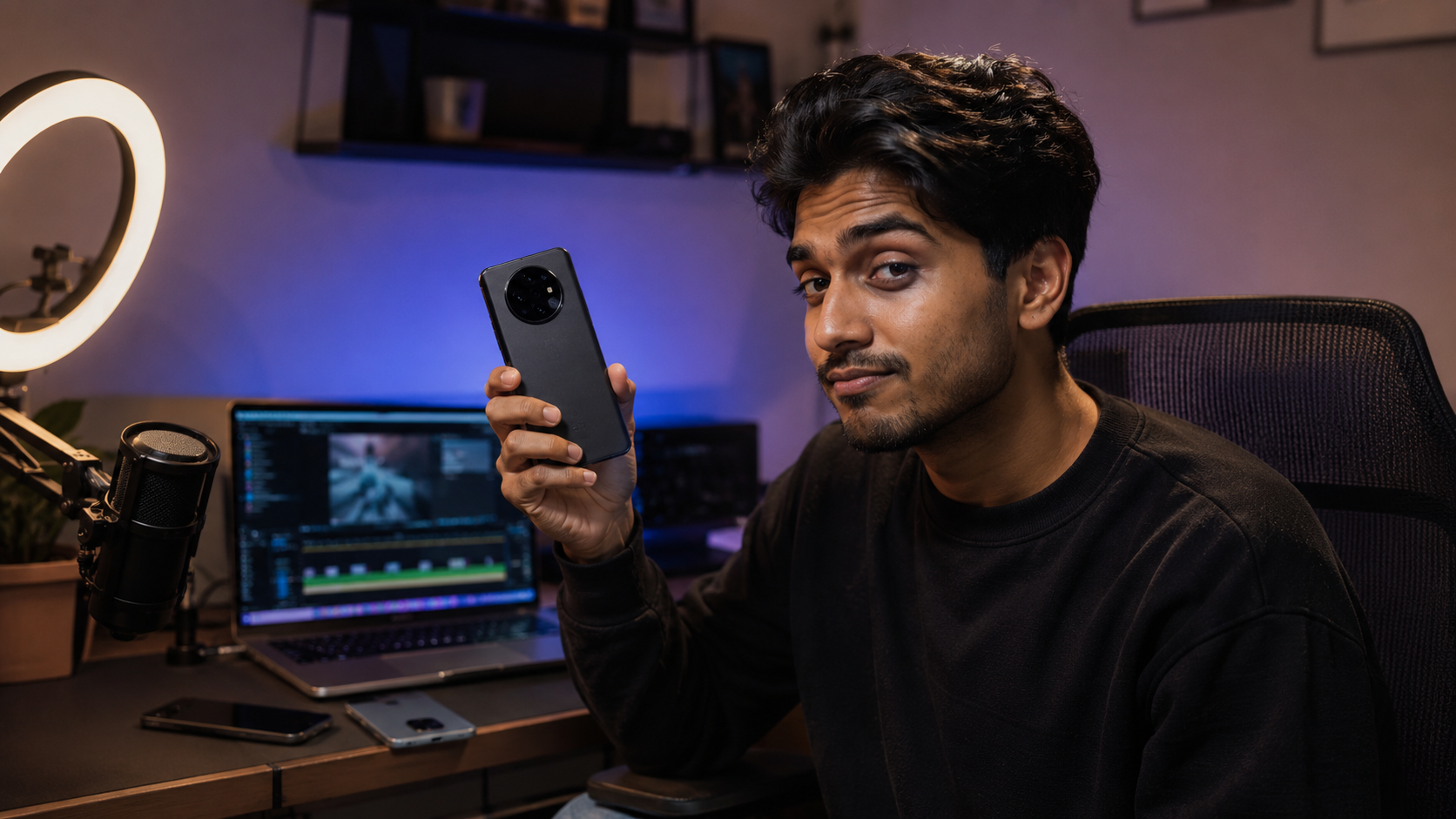
There's a particular genre of Indian tech content that has quietly become one of YouTube's most reliable formats: the creator, sitting in front of a ring light, holding an Android flagship, explaining in great detail why the iPhone is overpriced, behind the times, and frankly embarrassing compared to what you get for half the money. The video is shot on an iPhone.
This is not a contradiction these creators are unaware of. Ask any of them directly and most will tell you, with varying degrees of sheepishness, that the criticism is genuine and the iPhone is still sitting in their pocket. Understanding why says more about the state of the smartphone industry in 2026 than any spec comparison ever could.
The criticism is real, and most of it lands
Let's not bury the substantive complaints under a punchline. Indian tech creators have been among the sharpest critics of Apple's pace of feature rollout, and the receipts are real.
The Dynamic Island arrived in 2022 on the iPhone 14 Pro to widespread excitement, only for people to point out that notification bubbles attached to a hole-punch cutout had been a feature on certain Android devices for years. Apple Intelligence — the company's flagship AI push, announced with considerable fanfare at WWDC 2024 — still isn't available in India as of mid-2026, while Android flagships have had on-device AI features working in Hindi and other Indian languages for over a year. The ability to set default apps, sideload software, use widgets properly, customise the home screen beyond a limited set of options, charge with a universal cable, or transfer files without a proprietary tool — virtually every one of these was an Android standard that took Apple anywhere from three to eight years to match, and some it hasn't matched yet.
The frustration is particularly sharp in India because the price-to-feature gap hits differently here. An iPhone 15 Pro at its Indian launch price represented months of salary for a significant portion of the country, and "you're paying for features that Android had in 2019" is not an unfair thing to say in that context. The delayed India rollout of Apple Intelligence, a feature Apple itself considers the core value proposition of its current hardware generation, has only sharpened that frustration in 2026. You are, right now, buying a phone partly on the promise of AI that isn't available where you live yet.
So why is the iPhone still on every creator's desk
The camera — specifically video — is the answer nobody wants to give but everyone eventually does.
Indian creators make content for YouTube, Instagram, and increasingly for clients who want commercial-grade production value. On video, the iPhone's processing pipeline has maintained a lead that competing Android flagships have narrowed but not closed. Skin tones, stabilisation, colour science, and the consistency of output across different lighting conditions — particularly the difficult, mixed-light indoor conditions that are the default setting for most Indian apartments and studios — consistently test well in the iPhone's favour in real-world shooting, as opposed to controlled lab comparisons. For a creator whose livelihood depends on footage that looks professional without a professional camera crew, that margin matters more than whether Apple was first to add a hole-punch cutout.
And it isn't just the camera in isolation. The full workflow matters. An iPhone shooting LOG format footage, colour graded on a MacBook Pro in Final Cut Pro, exported and compressed for YouTube, is a pipeline that works — consistently, predictably, every time. That consistency is unglamorous but it is genuinely valuable when you're producing two to five pieces of content a week on a deadline. Mac remains the dominant platform for serious video editing among Indian creators with the budget to choose, and for the specific combination of Apple Log footage, ProRes, and Final Cut Pro, the Mac's optimisation is not matched by any Windows machine running the same software, because Apple doesn't make Final Cut for Windows. The ecosystem is a lock-in, yes, but it's a lock-in that produces results on deadline, and that's ultimately what a creator's business runs on.
The ecosystem point deserves more credit than it usually gets in these debates.
The criticism of Apple's ecosystem usually focuses on the lock-in — the way iMessage won't hand you your chat history if you leave, or how AirDrop only works between Apple devices. That's a fair critique of the strategy. But the experience of that ecosystem for someone already inside it — the way a clip from an iPhone appears on a MacBook without any action taken, the way a notification on the phone mirrors to the laptop, the way Sidecar turns the iPad into a second screen without a cable — runs so smoothly and so consistently that it becomes part of how you work rather than a feature you consciously use. That consistency, when you're comparing it against a Windows laptop and an Android phone that require a rotation of third-party apps and workarounds to approximate the same thing, is where the ecosystem wins. It's not glamorous. It's just reliable.
The duopoly context nobody talks about enough
There's a structural reality sitting underneath this entire conversation that rarely gets named directly: we have two major smartphone operating systems, and that's it. The choice isn't between the iPhone and an ideal alternative — it's between the iPhone and Android, and "Android" is not a single thing but a family of operating systems, manufacturer skins, and update policies that range from excellent to genuinely bad depending on which device and which price point you're talking about.
For a creator in India who has invested in content production as a profession and needs to show both major platforms to their audience, owning an iPhone isn't even entirely a personal preference decision. It's an editorial one. Your audience uses both. Your brand clients may require deliverables shot on specific devices. If you're reviewing tech, you need both ecosystems represented. The iPhone becomes, in some cases, less of a choice and more of a professional requirement — and the criticism of its limitations is itself content, because your audience recognises the tension.
What this actually tells us
The Indian creator who criticises the iPhone and shoots on it anyway isn't being hypocritical. They're being pragmatic about a market that has given them two real choices, neither of which is perfect, and choosing the one that solves their specific, concrete, revenue-affecting problems best — camera output, ecosystem reliability, and video editing pipeline — while being honest about what it costs and what it fails at.
What it tells us about Apple is more uncomfortable: a company that retains its most publicly critical power users is a company that has built something sticky enough to outlast the criticism. Whether that's a sign of genuine product excellence, effective lock-in, or some inseparable combination of both is the question Indian creators are, in their own way, answering on camera every week. Just not the way Apple's marketing team would write it.
---
The opinions and observations in this piece draw on publicly documented creator feedback, device-category testing data, and platform ecosystem analysis. Gadgets365 receives no compensation from Apple or any competing manufacturer.