Prime Day discounts have put both the iPhone 17 and Galaxy S25 Ultra within closer reach of each other's price bracket this week, which makes this the right moment to settle a question a lot of Indian buyers are actually asking right now: which one is worth your money.
The case for the Galaxy S25 Ultra
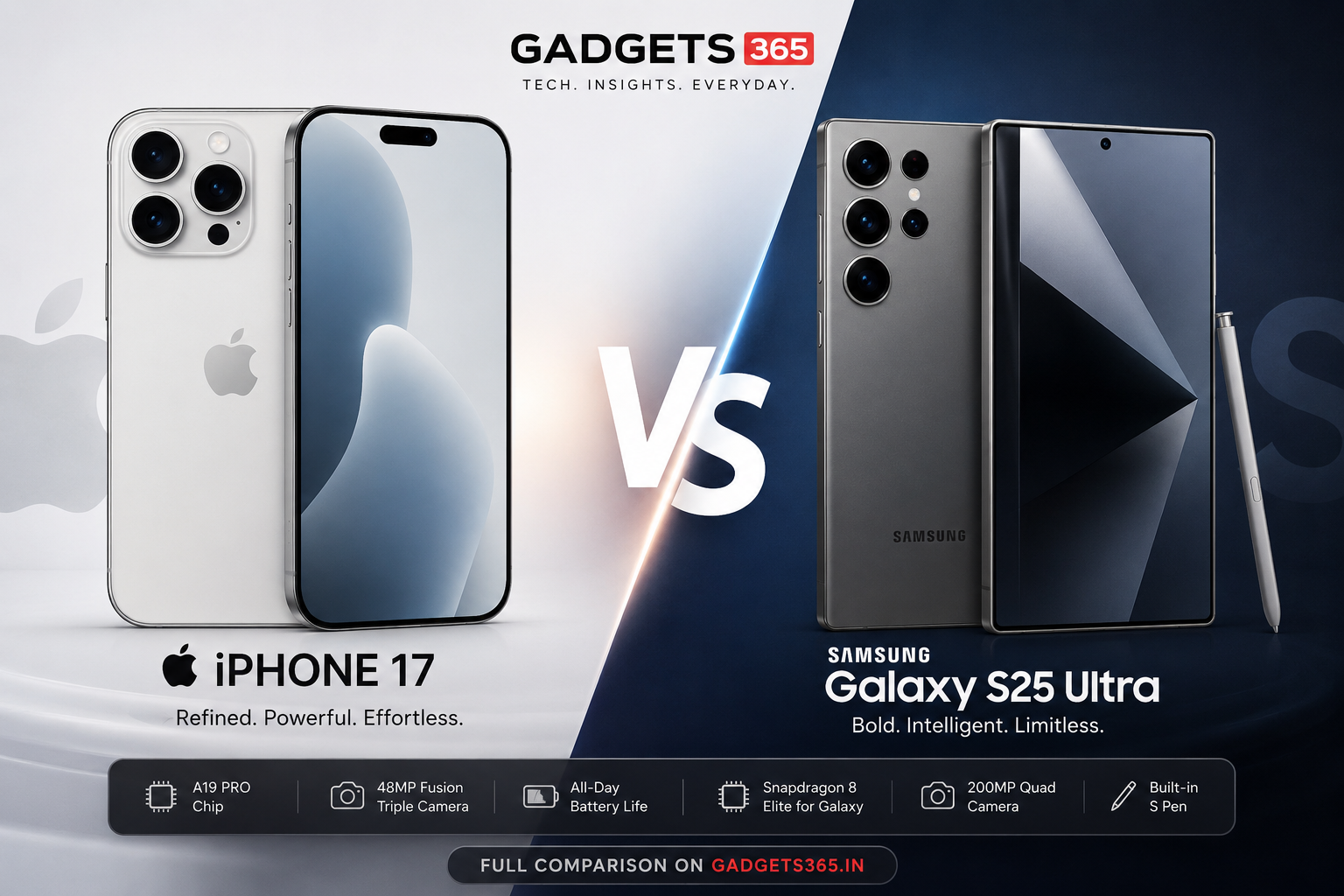
On raw specifications, the S25 Ultra wins more categories than it loses. Its Dynamic AMOLED 2x display measures 6.9 inches against the iPhone 17's 6.3 inches, giving it a genuine size advantage for anyone who consumes a lot of video or reads extensively on their phone. The processor runs at a higher clock speed too, at 4.47GHz compared to the iPhone 17's 4.26GHz, though clock speed alone rarely tells the full performance story once real-world app behavior and thermal management enter the picture.
Camera hardware is where the gap widens most visibly. The S25 Ultra's 200MP main sensor dwarfs the iPhone 17's 48MP on paper, and Samsung backs it with a four-camera array covering ultrawide, 5x telephoto, and 3x telephoto ranges, against the iPhone's three-lens ultrawide, main, and 4x telephoto setup. Battery capacity favors Samsung clearly too, with a 5,000mAh cell against the iPhone 17's smaller 3,692mAh battery, though iOS's power management has historically closed some of that gap in real-world endurance. The S25 Ultra also keeps a physical SIM slot in most markets and retains a fingerprint sensor alongside its S Pen support, both genuine functional advantages for buyers who value that flexibility.
The case for the iPhone 17
Apple's strengths sit in places a spec sheet undersells. The Camera Control button gives one-handed access to shooting modes and lens switching that Samsung has no direct equivalent for, and Apple's computational photography pipeline, including its portrait mode bokeh processing and color consistency across all three lenses, remains a genuine differentiator even when the underlying megapixel count is lower. The iPhone 17 also offers up to 2TB of storage, double what the S25 Ultra tops out at, a meaningful consideration for buyers who shoot a lot of 4K video or never delete anything.
Then there is the ecosystem argument, which matters more in practice for many buyers than any individual spec. For anyone already invested in Mac, iPad, or AirPods, the iPhone's tighter cross-device handoff and continuity features carry real everyday value that doesn't show up in a side-by-side comparison table.
Both phones are excellent, so it mainly comes down to which operating system and ecosystem you already prefer.
What actually decides this for most buyers
Price is where this comparison gets genuinely interesting rather than academic. The S25 Ultra's base configuration starts meaningfully below the iPhone 17 Pro Max's entry price, and Prime Day-style sale pricing tends to compress that gap even further, since Android flagships typically see steeper festival and sale discounts in India than Apple hardware, which rarely drops far from its listed price even during major sales.
The India angle
For Indian buyers specifically, camera preference tends to split fairly predictably. Buyers upgrading from a mid-range Android phone often gravitate toward the S25 Ultra's zoom range and detail-heavy 200MP sensor, especially for photographing festivals, travel, and family events where reach and flexibility matter more than color science subtlety. Buyers coming from an older iPhone, or those prioritizing resale value, tend to stick with Apple, since iPhones consistently hold a higher percentage of their original price on India's secondhand market than any Android flagship, a factor that meaningfully changes the real cost of ownership over two to three years.
EMI availability also shapes this decision more in India than in most markets. Both phones are typically available through similar no-cost EMI schemes during sale periods, but the S25 Ultra's lower starting price means a shorter EMI tenure reaches the same monthly outlay, an important detail for India's large EMI-financed buyer base. Physical SIM support on the S25 Ultra also carries more weight in India than in markets further along the eSIM transition, since dual-SIM usage, often across a personal and work number, remains far more common among Indian smartphone users than in the US or Europe.
What to watch
Watch how far Prime Day and equivalent sale pricing pushes each phone's effective India street price this week, since the gap between them, not the list price, is what actually decides this comparison for most buyers on a budget. If you already own recent devices in one ecosystem, that continuity argument will likely outweigh any individual spec difference covered here.
Published July 4, 2026. Gadgets365 will update this article as more information becomes available.